

IBC Basics: A Practical Guide to Institutional Biosafety Committees
Every day, researchers around the world work with recombinant DNA, infectious agents and other biological materials that carry real risk if handled carelessly. Standing behind that work, usually out of public view, is a body most people outside the research world have never heard of: the Institutional Biosafety Committee, or IBC. For anyone new to a research institution, or anyone trying to understand why a promising study can’t start until a committee signs off, it’s worth understanding what an IBC actually is, what it does and why it matters.
An IBC is a locally organized committee, required at any institution that receives NIH funding for recombinant or synthetic nucleic acid molecule research, that reviews and oversees research involving biohazardous materials. Its job is to make sure that work involving things like engineered viruses, gene-editing tools, human pathogens, or select agents is conducted safely, ethically and in compliance with a dense web of federal and institutional regulations. In this article, we’ll walk through what an IBC does, who sits on one, how the approval process works, the regulations that govern IBCs and the challenges these committees face as science moves faster than the rules that govern it.
What Does an IBC Do?
Overview of Responsibilities
At its core, an IBC exists to catch problems before they happen. That means reviewing research involving recombinant DNA, infectious agents, and other biological materials before a single experiment begins, assessing the risk of proposed biohazardous activities, and making sure the institution’s research stays within the bounds of national and institutional regulations. An IBC isn’t a rubber stamp; it’s an independent check that asks whether a proposed study has the right containment, the right training and the right safeguards for the hazard level involved.
Key Functions of an IBC
In practice, that responsibility breaks down into a handful of recurring functions. The committee reviews protocols and research proposals line by line, evaluating the biological agents involved and the containment level required. It conducts risk assessments and hazard evaluations, weighing factors like the transmissibility of an agent, the route of exposure and the availability of treatment or vaccines. It provides training and oversight for research staff, ensuring that the people doing the work understand the hazards and the required precautions. And it doesn’t stop once a protocol is approved: IBCs are responsible for continuous monitoring of safety practices, following up on approved research to confirm that the work in the lab still matches what was approved on paper.
Composition of an Institutional Biosafety Committee
Who Makes Up an IBC?
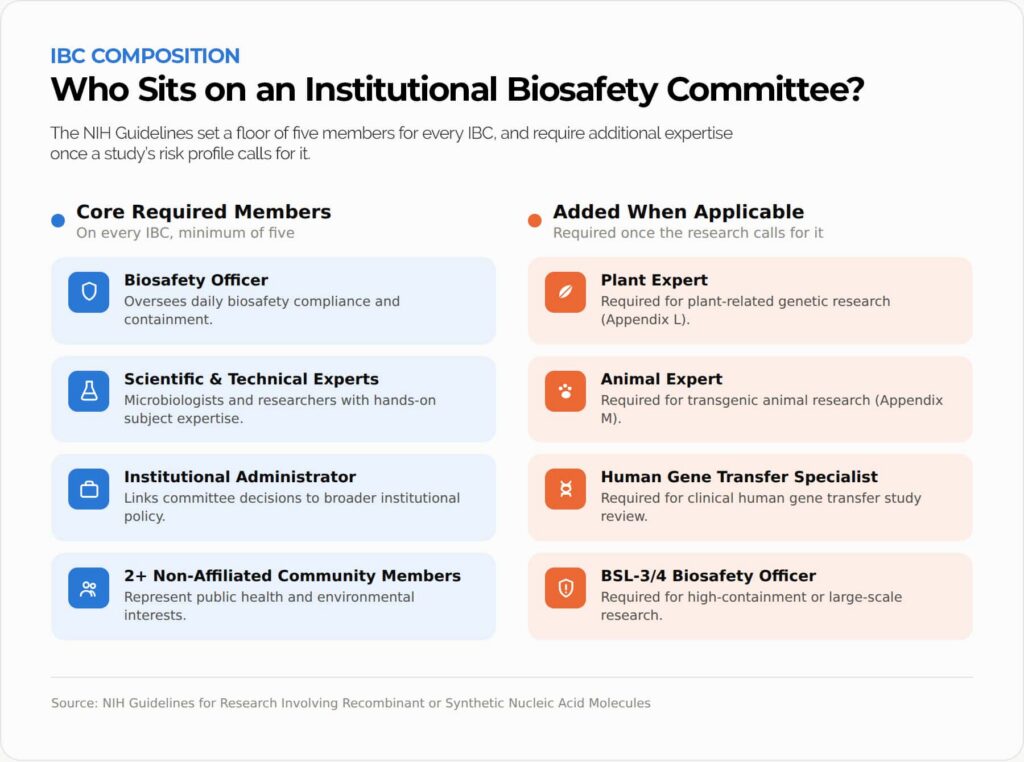
An effective IBC is, by design, not a committee of specialists in only one field. Under the NIH Guidelines for Research Involving Recombinant or Synthetic Nucleic Acid Molecules, an IBC must have a minimum of five members, and most research-intensive institutions have considerably more. Membership typically includes a biosafety officer, microbiologists and other scientists with hands-on experience in the type of research being reviewed, institutional administrators and sometimes legal or compliance experts. Critically, the NIH Guidelines also require at least two members who are not affiliated with the institution, representing the interests of the surrounding community in matters of public health and environmental protection.
That mix isn’t incidental. A committee made up entirely of researchers might be well-equipped to evaluate the science but miss community or ethical concerns; a committee without hands-on scientific expertise might be cautious to the point of blocking legitimate research it doesn’t fully understand. The diversity of an IBC’s membership is what allows it to weigh scientific merit, safety and public accountability at the same time.
Required Expertise and Roles
Beyond the baseline membership, the specific expertise required on an IBC scales with the type of research an institution conducts. A biological safety officer is generally required for institutions doing higher-containment (BSL-3 or BSL-4) research, large-scale culture work, or research involving gene drive modified organisms. Institutions conducting plant-related genetic research need a plant expert on the committee, and those working with transgenic animals need someone with relevant animal biosafety expertise. Institutions running human gene transfer studies must include someone with clinical and human subjects expertise as well. Each member’s role in the committee’s decision-making process is to bring a specific lens, biosafety, ethics, lab management, or regulatory compliance, to protocols that often require all of them at once to evaluate properly.
IBC Approval Process: How It Works
Steps to Gain IBC Approval
For a researcher, the IBC approval process usually starts with submitting a detailed research protocol describing the biological agents involved, the experimental procedures, the containment measures in place and the qualifications of the personnel doing the work. From there, the committee conducts its risk assessment and review, which may involve written questions back to the investigator, a full committee discussion, or, for higher-risk work, a site visit to the lab itself. If the committee identifies gaps, whether that’s insufficient containment, unclear waste disposal procedures, or missing training records, it communicates that feedback and requires revisions before final approval. Only once the IBC is satisfied that the protocol meets the applicable safety standards does the research receive approval to proceed.
Types of Research Requiring IBC Approval
Not every biology experiment needs to go through this process, but a wide range of work does. Recombinant DNA research, meaning any experiment that creates or uses molecules formed by combining DNA from different sources, is the foundational category the NIH Guidelines were built around. Work involving select agents and toxins, the roughly five dozen biological agents and toxins the federal government has identified as posing a severe threat to human, animal, or plant health, requires IBC review in tandem with separate federal registration. And any research involving human pathogens or other biohazardous materials, even outside the recombinant DNA context, typically falls under IBC oversight at institutions that have adopted a broad biosafety policy.
Approval vs. Exemption
Not all recombinant DNA work requires the same level of scrutiny, and the NIH Guidelines build in categories of research that can proceed with a lighter touch. Some experiments qualify for exempt status because the underlying host-vector systems are well characterized and pose negligible risk; others fall under a category that requires only notification to the IBC at the time work begins rather than approval beforehand. Understanding which category a given experiment falls into, and confirming that determination with the IBC rather than assuming it, is one of the more common points of confusion for researchers who are new to the process. When in doubt, the safer path is always to ask the committee before starting the work, not after.
Key Regulations and Guidelines Governing IBCs
Overview of Major Regulations
IBCs don’t operate in a regulatory vacuum; they exist to implement a specific set of federal rules at the local level. The NIH Guidelines for Research Involving Recombinant or Synthetic Nucleic Acid Molecules are the foundational document, first issued in 1976 and updated regularly since, and they’re the reason IBCs exist in their current form at institutions receiving NIH funding. Layered on top of that are the CDC and USDA Select Agent Regulations, jointly administered through the Federal Select Agent Program, which govern the possession, use, and transfer of the select agents and toxins considered the highest-consequence biological materials. The CDC’s Division of Regulatory Science and Compliance handles agents that primarily affect human health, while USDA’s Animal and Plant Health Inspection Service oversees agents affecting agriculture. Beyond these biosafety-specific frameworks, general workplace and environmental regulations from OSHA and the EPA also apply to research labs, covering everything from chemical hazard communication to hazardous waste disposal.
International Guidelines
Biosafety obligations don’t stop at the U.S. border, and institutions with international collaborators or field sites need to look beyond domestic regulation. The World Health Organization’s Laboratory Biosafety Manual is the most widely referenced international biosafety standard, and it has moved toward a risk-based approach that asks institutions to match containment and controls to the actual risk of a given procedure rather than applying one-size-fits-all rules by agent classification alone. For research involving animal pathogens, the World Organisation for Animal Health, still commonly known by its historical acronym OIE, sets standards that many countries incorporate into their own animal health and biosafety regulations. Institutions conducting global health research typically need to reconcile U.S. requirements with these international frameworks, and often with host-country regulations as well.
The Role of Biosafety in Protecting Public Health
Why IBCs Matter in Preventing Biological Hazards
It’s easy to think of IBC review as paperwork standing between a researcher and their experiment, but the stakes behind that paperwork are real. Laboratory accidents involving infectious agents have led to worker infections, environmental releases, and in rare but well-documented cases, wider outbreaks that trace directly back to insufficient containment or oversight. The IBC’s role in preventing lab accidents, contamination, and the spread of disease is preventive by design: by requiring the right containment level, the right training, and the right emergency procedures before work begins, the committee reduces the odds that a manageable incident becomes an unmanageable one.
Ethical Considerations in Research
Biosafety oversight also carries an ethical dimension that goes beyond physical containment. Researchers who work with pathogens, gene-editing tools, or other biohazardous materials carry a responsibility not just to themselves but to their colleagues, their institution and the broader public who never consented to bear any risk from the work. An IBC gives that responsibility an institutional home, a body whose job is specifically to ask whether a study’s potential benefits justify its risks, and whether the safeguards in place are proportionate to what could go wrong. That question matters more, not less, as research moves into areas like gain-of-function studies and dual-use research of concern, where the line between advancing science and creating new hazards can be genuinely difficult to draw.
Common Challenges and Best Practices for IBCs
Challenges Faced by IBCs
IBCs operate under real tension. They’re asked to protect safety without becoming an obstacle to legitimate scientific progress, a balance that’s harder to strike than it sounds, especially when a protocol involves a genuinely novel technique the committee hasn’t reviewed before. Emerging risks compound the difficulty: new and re-emerging pathogens, rapidly evolving gene editing technologies like CRISPR, and increasingly complex synthetic biology work all move faster than regulatory guidance can keep pace with, leaving committees to apply existing frameworks to situations those frameworks weren’t written for. Committees also face practical challenges around member turnover, workload and keeping technical expertise current in fields that change quickly.
Best Practices for Effective IBCs
The institutions that manage these challenges well tend to share a few habits. They invest in regular training and education for committee members, treating biosafety expertise as something that needs active maintenance rather than a box checked once at appointment. They maintain clear, ongoing communication channels with researchers, so that investigators understand what the committee needs from a submission and committees understand the practical realities of the work they’re reviewing, rather than treating review as an adversarial, one-way process. And they stay current with evolving regulations, tracking updates from NIH, CDC, USDA and other bodies rather than assuming that last year’s compliance framework still applies. None of this is glamorous work, but it’s what separates an IBC that functions as a genuine safety partner from one that’s seen as a bureaucratic hurdle.
Conclusion
Institutional Biosafety Committees sit at an unusual intersection: part scientific reviewer, part regulator, part ethics board, and part community representative, all rolled into one committee that most research doesn’t happen without. Understanding the basics, what an IBC does, who serves on one, how approval works, and the regulatory framework behind it, matters whether you’re a researcher submitting a protocol for the first time, an administrator building out a biosafety program, or simply someone curious about how biological research gets kept safe. As the pace of biotechnology continues to accelerate, from gene editing to synthetic biology to novel gene drive systems, the work IBCs do to keep that progress safe, ethical and accountable isn’t going away. If anything, it’s becoming more important.
Trust Sabai With Upholding Your Ethical Standards
Navigating IBC review shouldn’t be the bottleneck that slows down a promising study. Sabai’s IBC Services give sponsors, CROs, and research sites a faster, better-supported path through committee review, whether that means standing up a flexible, centralized IBC, building a specialized human gene transfer committee, or coordinating concurrent IBC and IRB review across multiple sites. Our team handles the details that typically eat up study startup time: NIH registration, customized risk assessment documents, and personalized education for new sites, so your researchers can focus on the science instead of the paperwork.
With Sabai’s IBC Concierge and Concierge Plus services, that support doesn’t end at initial approval. We stay engaged through continuing review, protocol amendments, and pre- and post-review action items, providing the kind of white-glove, global support that keeps studies moving from submission through completion.
Ready to see how Sabai can streamline your next IBC submission?