

Pay No Attention to the Man Behind the Curtain: Why Conflicts of Interest Belong in Plain Sight
Transparency is a Participant Protection
In The Wizard of Oz, the great and powerful Wizard keeps up his image only until Toto pulls back the curtain. Behind the smoke, fire and booming voice is an ordinary man working the controls. His plea is one of the most famous lines in film history: “Pay no attention to that man behind the curtain!”
Clinical research has its own version of the man behind the curtain. Financial ties, professional incentives and institutional interests can shape how a study is designed, conducted and reported. Often these interests are perfectly legitimate. The problem starts when they stay hidden.
Conflicts of interest in clinical research are not rare, and having one is not wrongdoing. Keeping one out of view is where the risk to participants, data and public trust begins.
That is why conflict of interest oversight matters.
What Counts as a Conflict of Interest?
A conflict of interest exists when a secondary interest could influence, or appear to influence, professional judgment about a primary responsibility. In research, that primary responsibility is protecting participants and producing reliable results.
Common examples include:
- Equity or stock ownership in the study sponsor
- Consulting fees, speaking fees or honoraria from the sponsor
- Patents or royalties tied to the product being studied
- Compensation that depends on enrollment numbers or study outcomes
- Leadership or advisory roles with the sponsor
Conflicts are not always financial. Career advancement, publication pressure and personal relationships can also shape decisions in quieter ways.
The Three Curtains to Look Behind
Conflicts of interest can exist at several levels of a study. Each one needs attention.
Investigator Conflicts
Investigators make daily decisions about eligibility, consent conversations, adverse event assessment and protocol adherence. When an investigator has a financial stake in the outcome, even well-intentioned judgment can be questioned.
FDA regulations at 21 CFR Part 54 require sponsors to collect and report certain financial interests of clinical investigators. For federally funded research, 42 CFR Part 50, Subpart F requires institutions to identify, manage and report significant financial interests.
Institutional Conflicts
Institutions can have conflicts too. A university that holds equity in a startup, receives large gifts from a sponsor or licenses the technology being tested may face pressure, whether intended or not, to see a study succeed.
Institutional conflicts are often harder to spot because they sit above any single investigator. They can influence which studies move forward, how quickly they are approved and how problems are handled.
IRB Member Conflicts
The reviewers need to be free of conflicts as well. Under both the Common Rule (45 CFR 46.107) and FDA regulations (21 CFR 56.107), an IRB member with a conflicting interest may not take part in the initial or continuing review of that study, except to provide information the IRB requests.
Recusal is not a formality. It protects the independence of the review itself.
Why Hidden Conflicts Create Real Risk
When conflicts stay behind the curtain, the effects can reach every part of a study:
- Participants may enroll without knowing about interests that could matter to their decision
- Risk assessments and adverse event reporting may be questioned
- Data integrity and published results may lose credibility
- Sponsors and sites may face regulatory findings and reputational damage
Perhaps most importantly, hidden conflicts erode trust. Research depends on the public’s willingness to take part. When a conflict comes to light after the fact, the damage often goes well beyond a single study.
Pulling Back the Curtain: How Conflicts Are Managed
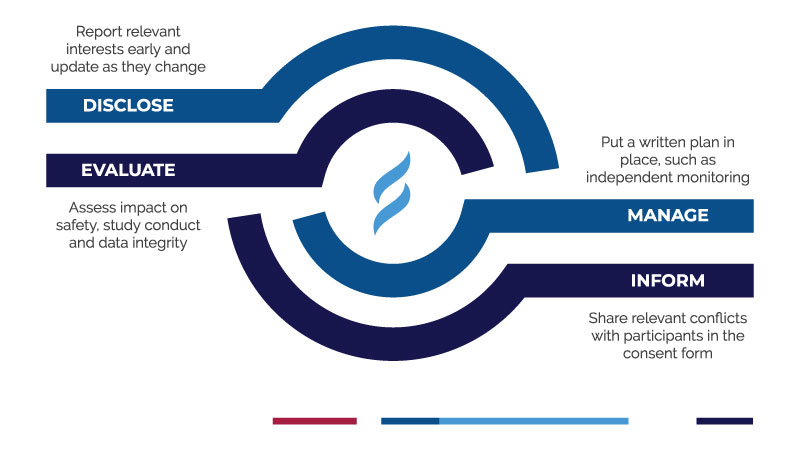
Most conflicts do not end a study. They are managed. Effective conflict of interest oversight usually includes several connected steps.
Disclosure
Management starts with complete and timely disclosure. Investigators, key study personnel and institutions should report relevant interests before the study begins and update them as circumstances change.
Evaluation
Once disclosed, the conflict is reviewed to determine whether it could affect participant safety, study conduct or data integrity. The level of review depends on the nature and size of the interest and the investigator’s role.
Management Plans
When a conflict is significant, a written management plan sets out how the risk will be reduced. Plans may include:
- Independent monitoring of data or consent processes
- Changing who obtains informed consent
- Limiting the conflicted person’s role in the study
- Reducing or eliminating the financial interest
Disclosure to Participants
The IRB typically requires that the conflict be described in the informed consent document. Participants deserve to know about interests that could reasonably affect their decision to enroll.
The Value of Independent Review
Independence is one of the strongest tools for managing conflicts. An IRB that sits outside the institution conducting the research, and apart from the sponsor’s financial interests, can evaluate studies with fewer competing pressures.
Independent review does not remove the need for disclosure or management plans. It does add another layer of objectivity, giving sponsors, sites and participants greater confidence that decisions are driven by ethics and science.
Transparency Strengthens Research
Conflict of interest oversight is sometimes seen as extra paperwork or a sign of distrust. In reality, it strengthens the entire research enterprise.
Organizations that handle conflicts openly often see:
- Greater sponsor and regulator confidence
- More credible study results
- Fewer surprises during audits and inspections
- Stronger relationships with participants and communities
Transparency turns a potential weakness into evidence of integrity.
Nothing to Hide, Nothing to Fear
The Wizard was not a villain. When Dorothy finally sees him for who he is, she calls him a very bad man. His reply: “Oh, no, my dear. I’m a very good man. I’m just a very bad wizard.”
His real mistake was not who he was. It was hiding behind the curtain instead of being honest about it. Conflicts of interest in research work the same way. Having one is common. Hiding one is the problem.
Ethical research does not ask anyone to pretend conflicts do not exist. It asks that they be disclosed, evaluated and managed in plain sight.
So when it comes to conflicts of interest, do the opposite of what the Wizard asked. Pay close attention to what is behind the curtain. Participants are counting on it.
Ready to Bring Clarity to Your Research Oversight?
At Sabai, we believe strong oversight starts with transparency. Our IRB, IBC and concierge service teams work alongside sponsors, sites and institutions to help identify potential conflicts early, put practical management plans in place and keep participant protection at the center of every study.
Whether you are launching a new trial or taking a closer look at your current processes, we are here to help you see what is behind the curtain.